Everything I read in May
While Thwarted by Overdue Notices at the Library and Slow Moving Audiobooks

I’m a slow reader when it comes to audiobooks. Very slow. I listen to them at the normal rate, not speeded up as some audiobook fans do. I concentrate on every word, trying to commit it to memory using a brain that’s still working on speech comprehension for my cochlear implant.
Long Time, Slow Read
So it took me a long time to read Tara Westover’s Educated, a fascinating read about growing up Mormon. The memoirs I tend to read tend to be light hearted, funny (think Susan Orlean’s Joy Ride as an example), but Educated was sobering. Not even half way through the book, I began to wonder the miracle of how Tara made it to adulthood given the serious mishaps she suffered. I wondered about her brothers, where they are now, given their brushes with death too. It’s no wonder they wanted to escape their home, they wanted to stay alive and not work on a forklift for the rest of their lives.
I ended up returning Educated while in the second part of the book, where Tara was attending college as a 17-year-old. She’s hearing some terms for the first time ever, words like “holocaust” than most American school children encounter as early as junior high or even earlier in history classes. But because Tara was homeschooled, she never heard this word and she got in trouble asking the class professor what it meant. He thought she was joking. She wasn’t. (Some readers might think this kind of major gap in a child’s history knowledge is reason enough to get rid of home schooling. But all school programs, even public ones, have their gaps. But I digress.)
So Tara’s story kept me gripped, horrified. The chapters detailing her physical abuse at the hands of a brother, left me completely unsettled. She wouldn’t have known to report him to authorities. And it mystified me that her brother would mistreat in this way…unless he too was abused just like this.
In Good Times and Bad
I wanted to read about happier times for Tara. Her bio on the book flap tells me she finished college, she has a master’s degree at Trinity College. So she actually even left the U.S. at one point, what an education that must have been to hear her native tongue spoken in a different way, to experience a culture very different from what she experienced growing up. If she wanted marriage and children, I pray that she has that now. But I don’t bother to look it up on Wikipedia, it’s too easy to do. I want to imagine a more joyful life. Maybe I’ll look it up at the library next time I’m there.
In the meantime, I’ll continue listening to Educated on Libby. I’ve got speech comprehension homework to do and I can read along with my phone’s live captions. However, It’s not nearly as fun as following along in a paperback or a hardcover.
In May, I also finished Country Matters by Clare Leighton, a writer and artist who was born in England and spent many years in the U.S. Country Matters is a delightful compilation of topics ranging from bell ringers, village fairs, cricket matches and more, topics that thrilled the romantic in me.
It was also heartening to read that she believed that country life would endure even with the encroachment of technology. She was an optimist in a profession peopled by cynics and skeptics. We could use more of her witty wisdom now as writers and readers alike despair.
If Leighton were alive today, I think she would still be optimistic about the persistence of the simple life lived among cows, goats and farm pastures. Her wood engravings beckoned you to just to trust and believe. My favorite is a village fair scene with a swirl of steam likely created with a burin called a multiple-line tool. That swirl of steam alone made me check out Leighton’s book. I want to create those same swirls myself in my work, because I too am a romantic.
Also in May, I returned Leighton’s Rural Life book because it was overdue, but notes on my phone show that I’ve checked out this book before. So it would have been a reread for me. But the contents are similar to Country Matters: stories and anecdotes about life in Southern England, where Leighton lived.
Unpacking a Life
I did finish poet Donald Hall’s Unpacking Boxes, a memoir. That line ‘unpacking boxes; threads the entire book, a clever way to work in tasks that all of us do through life as we carry boxes of material from earlier parts of our lives. It was delightful to read about his encounters with Robert Frost and other poets, not so delightful to read about how he used women through out his life. I wondered how his first and second wife reckoned with those dalliances. Hall might be a great poet, but his personal life was a mess. Does anyone else agree with me on this? I don’t know Hall’s poems too well.
There you have it: three books in a month, slowly savored like a small box of chocolates. I knew I wasn’t going to be finishing a half dozen books like some voracious readers do because, again, I’ve got homework. Speech comprehension for my cochlear implant slows me down, pitifully slow. I might well be like a first-grader with her finger on every word as she works her way from left to right across the page in a book.
It’s slow, but at least I won’t get stomach upset for reading too fast, right?
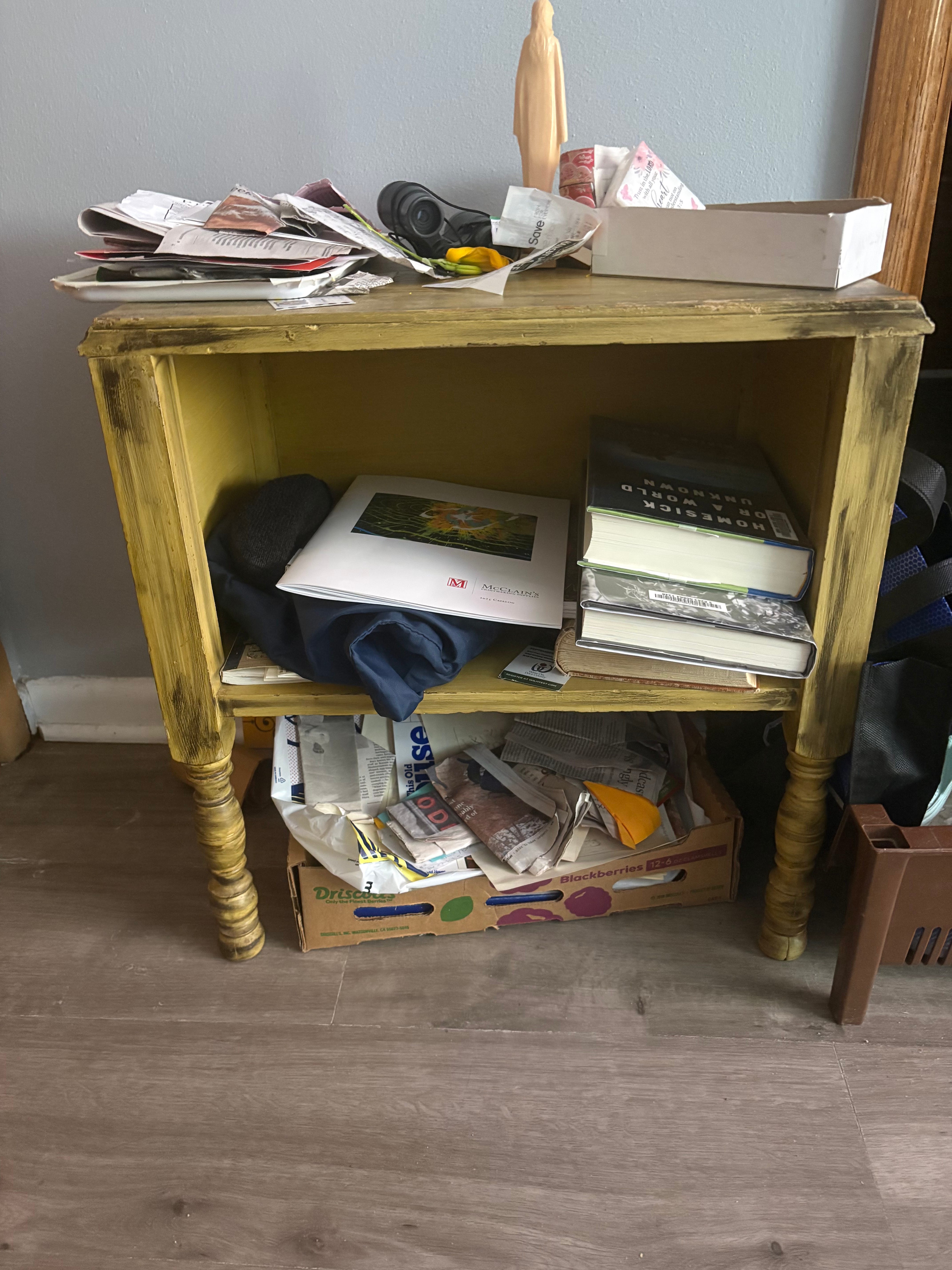
For more on my process, see my library shelf below. It’s messy, not organized at all. A jumble of papers, books and newspaper articles. But keeping my books here and not by my bed, I know where to find what library books are overdue. I do have an idea on how to tidy it up even make that back wall more decorative. I might hang a decorative 1940s floral curtain panel using a piece of doweling and adhesive wall clips, easy to do if I would only make the effort, the way I do returning overdue books.